
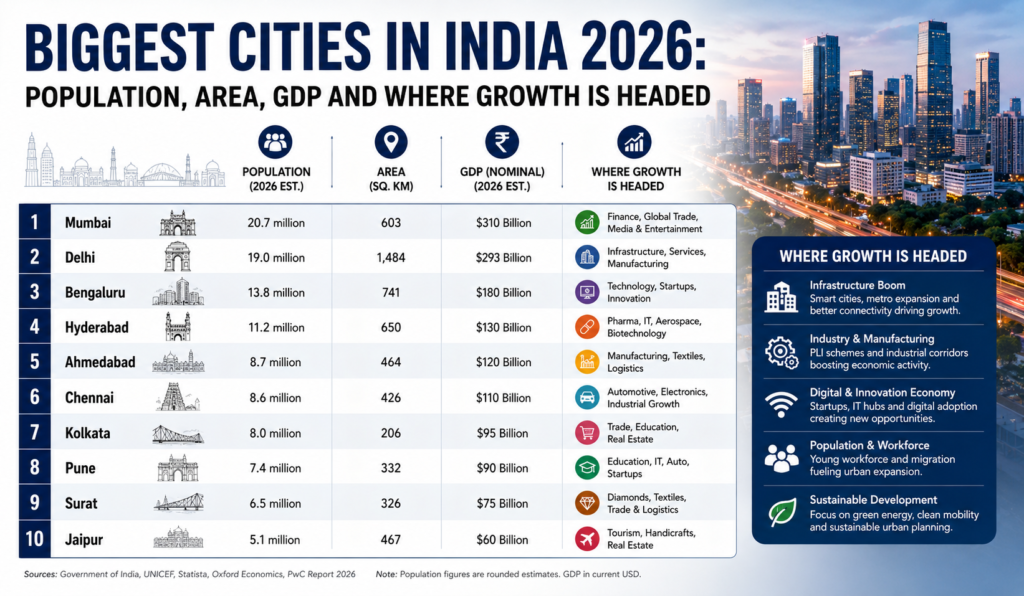
Delhi is India’s largest city in 2026 it leads both by urban-region population (an estimated 33–35 million) and by area (roughly 1,484 sq km). Mumbai is the most populous city within municipal limits (~18.4 million) and the largest by GDP (~$310 billion). Bengaluru, Hyderabad, Pune, Surat and the Noida–Gurugram belt of Delhi NCR are the cities where real estate growth is accelerating fastest.
Search “biggest cities in India” and you’ll meet the same recycled population table on a dozen sites. What almost none of them answer is the question buyers and investors actually care about: not just how big a city is today, but which cities are growing, why, and where that growth is turning into real estate value.
This guide covers all of it population, area, GDP, livability and investment potential with the 2026 numbers up front and the reasoning behind them, so you can make a property decision rather than just memorise a ranking.
Table of Contents
- Biggest Cities in India by Population in 2026
- Largest City in India by Area in 2026
- Biggest Cities in India by GDP in 2026
- Best Cities for Real Estate Investment in India in 2026
- Which Is the Fastest-Growing City in India?
- Most Livable City in India in 2026
- Which Cities Will Join India’s Biggest by 2030?
- Where India’s Growth Story Goes Next
- Frequently Asked Questions
Biggest Cities in India by Population in 2026
A quick note that matters more than most guides admit: India has not completed a census since 2011. Every “2026 population” you see here and everywhere else is an estimate built on projection and UN urbanisation data, not fresh municipal counts. We flag this because the honest answer to “how big is this city” depends entirely on whether you mean the city proper or the full metropolitan region.
Here are the biggest cities in India in 2026 by metropolitan / urban-agglomeration population (the figure that actually drives housing and job demand):
| Rank | City / Region | Estimated Metro Population (2026) |
|---|---|---|
| 1 | Delhi NCR | ~33–35 million |
| 2 | Mumbai (MMR) | ~21–22 million |
| 3 | Kolkata | ~15–16 million |
| 4 | Bengaluru | ~13–14 million |
| 5 | Chennai | ~11–12 million |
| 6 | Hyderabad | ~10–11 million |
| 7 | Ahmedabad | ~8–9 million |
By city-proper limits the order shifts Mumbai (~18.4 million) edges ahead of Delhi (~16.3 million), because Delhi’s population is spread across a much larger NCR footprint. Neither figure is “wrong”; they answer different questions. City-proper numbers matter for municipal governance, while metro-region numbers are what tell you where housing demand and rental markets are strongest.
For the underlying data, the Census of India 2011 remains the last official source, and World Population Review’s India city data offers the most-cited current projections.
Largest City in India by Area in 2026
Delhi is the largest city in India by area in 2026, covering roughly 1,484 sq km. The exact figure moves between about 1,397 and 1,484 sq km depending on whether the full National Capital Territory boundary or a narrower municipal-corporation limit is measured.
| Rank | City | Approx. Area (sq km) |
|---|---|---|
| 1 | Delhi (NCT) | ~1,484 |
| 2 | Bengaluru | ~741 |
| 3 | Visakhapatnam | ~682 |
| 4 | Mumbai | ~603 |
That area gap explains a lot about pricing. Mumbai ranks second by population but covers barely 603 sq km, which is a core reason its per-square-foot prices run far above Delhi’s or Bengaluru’s there is simply less land to build on. Cities that expand horizontally (Delhi, Bengaluru, and increasingly Pune and Hyderabad) have more room for townships, expressways and integrated communities, which is exactly where large-format residential supply comes from.
Biggest Cities in India by GDP in 2026
Economic output is the clearest signal of a city’s job market and, by extension, its long-term housing demand.
| Rank | City | Est. GDP (2026) | Core Economic Engine |
|---|---|---|---|
| 1 | Mumbai | ~$310 billion | Finance, BFSI, media |
| 2 | Delhi NCR | High (multi-hub) | Services, corporate, government |
| 3 | Bengaluru | Strong, rising | IT, GCCs, startups |
| 4 | Hyderabad | Strong, rising | IT, pharma, biotech |
| 5 | Chennai | Established | Manufacturing, auto, IT |
Mumbai remains India’s largest city by GDP at roughly $310 billion, powered by the country’s financial core. But the fastest growth in economic output is happening in the technology and Global Capability Centre (GCC) hubs Bengaluru and Hyderabad and across the diversified corporate belt of Delhi NCR.
Best Cities for Real Estate Investment in India in 2026
Population and area tell you how big a city is. They don’t tell you where growth is translating into property returns. Weighing GDP momentum, price-appreciation forecasts and infrastructure spending together gives a far more useful picture:
| Rank | City / Micro-market | Key Growth Driver | Est. Annual Appreciation (2026) |
|---|---|---|---|
| 1 | Bengaluru | IT and GCC expansion | 8–12% |
| 2 | Noida & Greater Noida (NCR) | Jewar airport + expressway corridors | 10–15% |
| 3 | Gurugram (NCR) | Corporate and luxury housing demand | Leading ultra-luxury segment |
| 4 | Surat | Diamond and textile industry, 9%+ GDP growth | 10–20% |
| 5 | Hyderabad | IT and pharma, western-corridor growth | Strong |
| 6 | Pune | IT and manufacturing balance | 5–10% |
| 7 | Mumbai (mid-segment) | Land scarcity, sustained demand | 8–15% |
A few things a pure population ranking would completely miss stand out here.
Surat barely registers on most “biggest cities” lists, yet it sits near the top on growth momentum it handles roughly 90% of the world’s diamond polishing and is posting 9%+ annual growth.
Noida and Gurugram are both part of Delhi NCR but are driven by genuinely different catalysts. Gurugram runs on corporate and luxury demand; Noida and Greater Noida are being reshaped by a single generational infrastructure project the Noida International Airport at Jewar plus the Noida, Yamuna and DND expressways. Lumping them into one “Delhi NCR” line would hide that distinction entirely.
This is where established, RERA-approved developers matter. In fast-moving corridors, who you buy from is as important as where. Prateek Group’s residential projects across Noida and Ghaziabad from Prateek Canary in the low-density Sector 150 sports-city belt to ready-to-move homes in Sector 61 and Sector 77 sit precisely along the NCR corridors that most 2026 investment forecasts single out.
Which Is the Fastest-Growing City in India?
It depends on the metric and any honest answer says so. By raw annual growth rate, Surat is most often named India’s fastest-growing city, with estimates above 9% a year driven by diamond polishing and textiles. By broader economic momentum tied to IT and GCC expansion, Bengaluru is just as frequently cited. Both claims are defensible; they simply measure different things.
Most Livable City in India in 2026
Pune currently ranks as the most livable city in India on the government’s Ease of Living Index, which weighs institutional quality, social factors, economic conditions and physical infrastructure together. Navi Mumbai leads on institutional quality, Greater Mumbai on physical infrastructure, and Chandigarh on economic conditions.
Notably, some of India’s largest cities by population Mumbai and Delhi among them don’t make the livability top tier, largely because of congestion and cost-of-living pressure relative to their size. If day-to-day quality of life is driving your decision as much as scale, that gap is worth weighing carefully.
Which Cities Will Join India’s Biggest by 2030?
Almost no coverage answers the forward-looking version of this question, which is the one that matters most for a long-horizon property decision.
Current projections indicate Ahmedabad, Bengaluru, Chennai and Hyderabad are each expected to cross 10 million residents by 2030, formally joining Delhi and Mumbai in India’s megacity tier. Separately, the number of Indian cities with populations above 1 million is projected to rise from 42 to 68 by 2030 meaning a large share of today’s mid-sized cities, with Surat and Pune among the most likely, will look structurally different within the decade.
If you’re investing on a five-to-ten-year view rather than a 2026 snapshot, this trajectory matters more than where a city ranks today.
Where India’s Growth Story Goes Next
Scale alone won’t tell you where the next decade of opportunity sits. IT-driven growth points toward Bengaluru and Hyderabad; industrial momentum toward Surat; infrastructure-catalyst growth toward Noida and the Jewar corridor; diversified corporate demand toward Gurugram and Mumbai’s suburbs. None of these paths are interchangeable, and today’s leaders won’t automatically be 2030’s.
For homebuyers and investors focused on Delhi NCR consistently ranked among India’s most promising real estate markets thanks to the metro network, expressways and the upcoming Jewar airport the smarter question isn’t “which city is biggest,” it’s “which growth driver am I betting on, and am I buying from a developer who will actually deliver.”
Frequently Asked Questions
Which is the biggest city in India in 2026?
Delhi is the biggest city in India in 2026 by both area (~1,484 sq km) and urban-region population (an estimated 33–35 million). Mumbai is the most populous city within municipal limits at roughly 18.4 million.
Which is the largest city in India by area in 2026?
Delhi is the largest city in India by area at roughly 1,484 sq km (varying by boundary definition), well ahead of Bengaluru (~741 sq km) and Visakhapatnam (~682 sq km).
What is the most populous city in India in 2026?
By full metropolitan region, Delhi NCR is the most populous at an estimated 33–35 million. By city-proper limits, Mumbai leads at about 18.4 million, followed by Delhi (~16.3 million) and Kolkata (~14 million).
Which is the fastest-growing city in India in 2026?
It depends on the measure. Surat is most often cited as fastest-growing by raw annual growth rate (over 9% a year), while Bengaluru is frequently named fastest-growing by IT and GCC-driven economic momentum.
Which is the most livable city in India in 2026?
Pune currently ranks as India’s most livable city on the Ease of Living Index, with Navi Mumbai, Greater Mumbai and Chandigarh leading on individual sub-metrics.
Which are the best cities for real estate investment in India in 2026?
Bengaluru, the Noida–Greater Noida and Gurugram belt of Delhi NCR, Surat, Hyderabad and Pune are the strongest 2026 markets, with projected annual appreciation ranging from around 5% to 20% depending on the micro-market and segment.