
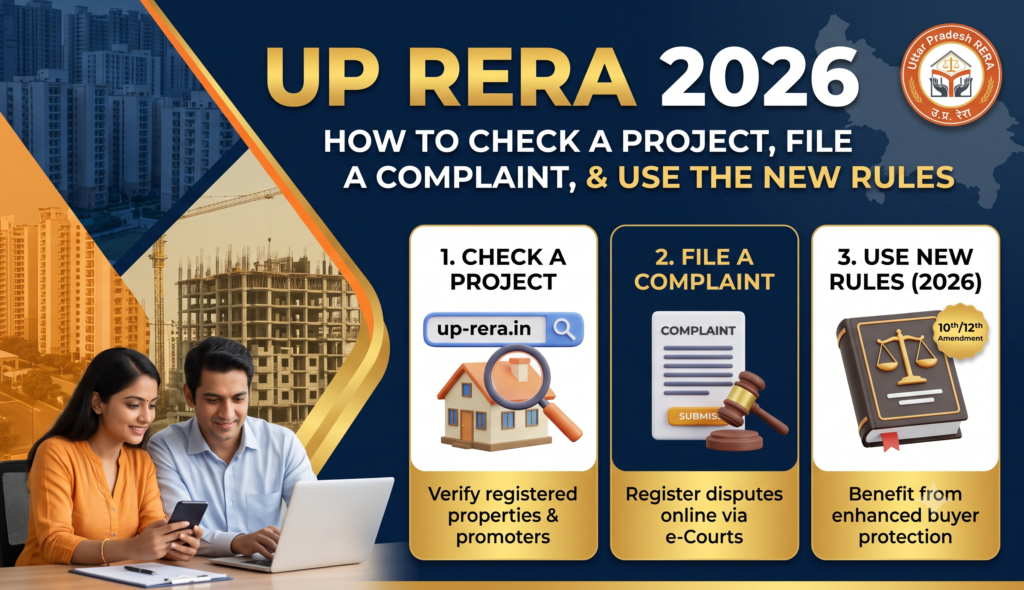
UP RERA is Uttar Pradesh’s real estate regulator, set up under the Real Estate (Regulation and Development) Act, 2016. Any project on more than 500 sq m of land, or with more than eight apartments, must be registered with it before a single unit is advertised or sold. You can verify any project free at up-rera.in, and file a complaint against a builder for Rs 1,000.
Two things changed this year that most guides haven’t caught up with. Since 25 March 2026, you can file a complaint even if the builder never registered the project. And builders can no longer charge you whatever they like to transfer a flat, with the fee now capped at Rs 1,000 within the family and Rs 25,000 outside it.
We’re a Noida developer, so we’re on the other side of this counter. Our own projects carry UP RERA numbers and file quarterly progress reports like everyone else’s. Here’s what the system actually gives you as a buyer, what it doesn’t, and how to use it properly.
What UP RERA is, in one minute
The central Act came into force on 1 May 2017. Uttar Pradesh notified its own rules in 2016 and put the state portal live on 26 July 2017. The regulator sits in Lucknow with a bench at Gautam Buddh Nagar that handles the NCR districts, which is where most of the state’s complaint volume comes from.
Its job is narrow and useful. It makes developers put their project on a public record before selling, hold buyer money in a dedicated account, declare a completion date they can be held to, and answer for the gap when they miss it.
Four provisions carry most of the weight:
| Provision | What it means for you |
|---|---|
| Section 3 | A registrable project cannot be advertised, marketed, booked or sold before registration. A pre-launch is not a launch |
| Section 13 | A developer cannot take more than 10% of the unit cost without a written, registered agreement for sale |
| Section 4(2)(l)(D) | 70% of the money collected from buyers must sit in a separate project account, to be drawn only against construction progress |
| Section 18 | If the developer misses the declared possession date, you can either take interest for the delay or walk away with a refund plus interest |
That last one is the provision buyers use most, and the one worth knowing by number when you sit across from a developer.
What changed in 2026: the 10th amendment
On 25 March 2026, UP RERA notified the 10th amendment to its General Regulations, 2019, under Section 85 of the Act. Three changes matter.
1. Complaints against unregistered projects are now accepted
This closed a genuinely perverse loophole. Until March, a developer who broke the law by never registering the project was, in practice, harder to pursue at RERA than one who complied. Buyers in unregistered projects were told the regulator had no jurisdiction.
Now the complaint is accepted and heard. UP RERA first assesses whether the project required registration. If it did, the promoter faces action for the breach, and the buyer’s grievance is then heard on merit. Skipping registration no longer works as a shield.
2. Transfer charges are capped
Builders had been charging transfer fees at their own discretion for years, often Rs 200 to Rs 1,000 per square foot, sometimes quoted as a percentage of the flat value. On a 1,500 sq ft flat at Rs 200 per sq ft, that’s Rs 3 lakh to change a name in a register.
Under the revision to Regulation 47:
| Type of transfer | Maximum the promoter can charge |
|---|---|
| To a legal heir or within the immediate family | Rs 1,000 |
| To anyone outside the family, including a resale buyer | Rs 25,000 |
UP RERA also clarified that succession transfers don’t require a fresh sale deed or lease deed to be executed. For families dealing with an inheritance, that removes a second layer of cost and paperwork on top of the fee itself.
If a builder has already charged you more than the cap since March, that’s a complaint you can file, and a refund you can ask for.
3. Quarterly progress reports got teeth
UP RERA set a filing window of 1 to 15 April 2026 for quarterly progress reports and has been imposing penalties on promoters who skipped them. The penalty exposure runs to 5% of project cost. Several Lucknow promoters were fined in the first round.
For you as a buyer, the QPR is the single most useful document on the portal and almost nobody reads it. It shows declared construction progress quarter by quarter. A project that has filed four consecutive QPRs showing movement is telling you something different from one with gaps.
How to check a UP RERA registration before you book
Five minutes, free, and the most valuable due diligence you’ll do.
1. Go to up-rera.in. Use the official portal, not a search result aggregator that mirrors the data. Mirrors go stale.
2. Open Registered Projects under the Search or Important Links section on the homepage.
3. Search by project name, promoter name, district or registration number. The number format looks like UPRERAPRJ followed by digits. Older registrations carry a shorter format.
4. Read the record, not just the fact that it exists. Four fields carry the real information:
- Registered completion date. Not the brochure date, not what the sales team says. This is the date the developer declared to the regulator and can be held to under Section 18.
- Registration validity. A lapsed registration is a warning sign worth asking about directly.
- Approved layout and sanctioned plan. Compare the tower count and unit mix against what you were shown.
- Quarterly progress reports. Check whether they’ve been filed, and what they say.
5. Check the promoter separately. Search Registered Promoters for the developer’s other projects and their status. A promoter with three delivered projects and current QPRs reads differently from one with a single registration and no filing history.
6. Check the defaulters list and any orders. UP RERA publishes lists of projects and promoters with orders against them. Read them before you pay, not after.
If a project isn’t on the portal at all, there’s nothing legally bookable, whatever the microsite or the price list says. We make this point in our guide to upcoming residential projects on the Noida Expressway, because the pre-launch pitch is still the most common way buyers get exposed in this market.
How to file a UP RERA complaint
Who can file: any aggrieved party. Buyer, promoter or agent.
Where: the complaint or e-Courts section of up-rera.in. Create a profile first with your email and mobile.
Which form:
| Form | Goes to | Use it for |
|---|---|---|
| Form M | The Authority | Possession, project delay, refund, compliance with declared terms |
| Form N | The Adjudicating Officer | A claim for compensation |
Fee: Rs 1,000.
What to attach: allotment letter, builder-buyer agreement, every payment receipt, the demand letters, and your written correspondence with the developer. Complaints fail on evidence far more often than on law. A WhatsApp thread where the site head promised a date is worth attaching.
How to write it: state the facts in date order, name the section you’re relying on, and say precisely what relief you want. “Refund of Rs 42,60,000 with interest under Section 18” is a claim. “Builder is harassing us” is not.
Timeline: the Act sets 60 days as the target for disposal. In practice, straightforward refund matters often run 90 days or more, and contested ones longer. Hearings are held at Lucknow or the Gautam Buddh Nagar bench, with video hearings available.
Conciliation first, sometimes. UP RERA runs conciliation forums at Lucknow and Greater Noida. Where the dispute is about a schedule rather than a breach, conciliation is usually faster and cheaper than a contested hearing. Where the developer has stopped responding, it’s a delay.
If you lose. Appeal to the UP Real Estate Appellate Tribunal within 60 days. Worth knowing: under Section 43(5), a promoter appealing an order has to pre-deposit at least 30% of the penalty, or the amount due to the allottee, before the appeal is heard. That provision exists specifically to stop appeals being used as a stalling tactic, and it’s the reason a RERA order has more practical force than buyers expect.
What a RERA number does not protect you from
This section is where most guides stop short, and it’s the honest part.
It isn’t a quality certificate. RERA regulates disclosure and timelines. It doesn’t inspect your plaster.
It isn’t a guarantee of delivery. Plenty of registered projects in Noida and Greater Noida have missed declared dates. RERA gives you a remedy after the fact. It doesn’t build the tower.
Recovery is the hard part. Winning a refund order is one thing. Getting the money out of a promoter with no liquidity runs through recovery certificates and the district administration, and it can take years. This is the single biggest gap between what buyers expect and what they get.
The 70% escrow rule is only as good as its enforcement. It’s a real protection, and it has also been circumvented.
Registration can lapse. A live number today doesn’t mean a live number in three years.
None of this is an argument against checking. It’s an argument for checking the developer as carefully as the registration, because the registration tells you the paperwork is in order and the delivery record tells you whether the paperwork will matter.
For developers and agents: what registration involves
Projects that must register: land above 500 sq m, or more than eight apartments, including each phase separately. Pure repair or renovation work is outside it.
Promoter first, project second. The promoter registers on the portal with PAN, Aadhaar, three years of income tax returns, audited balance sheets, title deed, encumbrance certificate and any collaboration agreement, then creates the project record.
Project documents: sanctioned plan, layout, approvals, proforma allotment letter, draft agreement for sale, the declaration under Section 4(2)(l), and the certificates from the project architect, engineer and chartered accountant.
Fees are calculated per square metre of proposed development area and vary by project type, with residential lower than commercial and plotted development lowest. The portal has an official fee calculator, and that’s the figure to work from rather than any number quoted in a blog, this one included.
Agents must register too. Anyone marketing or facilitating a sale, including channel partners and consultants, needs their own registration, renewed periodically. Selling an unregistered project exposes the agent, not just the builder.
Ongoing compliance is where registrations go wrong. Quarterly progress reports, project account discipline, and updating the portal when anything material changes. The April 2026 penalties were about QPRs, not about anything glamorous.
Using UP RERA alongside the other checks
A RERA number is one of four checks, not the whole diligence. Run it with the others:
- The registry position. Greater Noida now collects stamp duty at the booking stage, which changes both your cash flow and your legal standing. See our guide to the new stamp duty rules in Greater Noida.
- The valuation base. Confirm the notified circle rate for the sector on our Noida and Greater Noida circle rate tool before you agree a price.
- The authority dues. Ask whether the project carries pending land dues to the Noida or Greater Noida Authority. Unpaid dues stall registries regardless of RERA status.
- The delivery record. Not the brochure. The completed projects, and what the residents there say.
If you want a second opinion on a project you’re considering, including one that isn’t ours, our team will pull the RERA record and read it with you. We do this every week and we’ll tell you when something looks thin. You can see how we set out a project’s own registration position in our Prateek Canary review.
FAQs
What is UP RERA?
The Uttar Pradesh Real Estate Regulatory Authority, set up under the Real Estate (Regulation and Development) Act, 2016. It registers real estate projects and agents in the state, enforces disclosure and timeline obligations on developers, and hears complaints from buyers.
How do I check if a project is RERA registered in UP?
Go to up-rera.in, open Registered Projects under Important Links, and search by project name, promoter or registration number. Check the registered completion date, validity, approved plans and quarterly progress reports, not just that a record exists.
Can I file a complaint against an unregistered project?
Yes, since the 10th amendment took effect on 25 March 2026. UP RERA first assesses whether registration was required. If it was, action follows against the promoter and your complaint is heard on merit.
How much transfer fee can a builder charge in UP?
Rs 1,000 for a transfer to a legal heir or within the immediate family, and Rs 25,000 for a transfer to anyone else, including a resale buyer. Succession transfers also don’t need a fresh sale or lease deed.
What does it cost to file a UP RERA complaint?
Rs 1,000, filed online through the portal. Form M goes to the Authority for possession, delay or refund matters. Form N goes to the Adjudicating Officer for compensation claims.
How long does a UP RERA complaint take?
The Act sets a 60-day target for disposal. In practice, simple refund matters commonly take around 90 days and contested cases longer, depending on hearings and the developer’s response.
Which projects must register with UP RERA?
Any project on more than 500 sq m of land, or with more than eight apartments, including each phase separately. Projects involving only repair, renovation or redevelopment without reallotment are outside the requirement.
What is the 70% rule?
Under Section 4(2)(l)(D), a promoter must deposit 70% of the money collected from buyers into a separate project account, withdrawable against certified construction progress. It’s meant to stop funds from one project being diverted into another.
Can I get a refund if my project is delayed?
Section 18 gives you a choice. Stay in the project and claim interest for every month of delay, or withdraw and claim a refund of what you’ve paid with interest. Which is better depends on the project’s realistic completion odds, not just the legal position.
Does a RERA registration guarantee the project will be delivered?
No. It guarantees disclosure and gives you a remedy if the developer misses the declared date. Assess the promoter’s delivery record separately.
Verified on 14 September 2026 against UP RERA notifications and the official portal at up-rera.in. Regulations change by notification and fee schedules are revised periodically. Confirm current requirements on the official portal or with your advocate before acting. This is general information, not legal advice.