
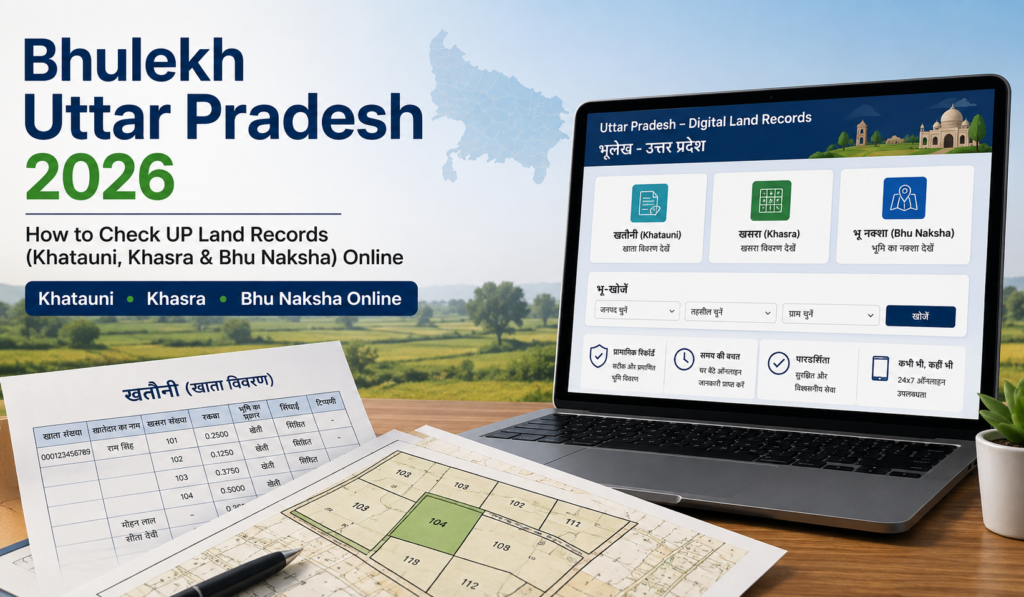
Before you pay a single rupee for land in Uttar Pradesh, you should know exactly who owns it, how big it is, and whether it is tied up in a dispute. Bhulekh Uttar Pradesh lets you check all of that from your phone, for free, straight from the state’s official records. Here is how to use it properly, and what an experienced buyer looks for.
We help clients close property deals across UP, and the same problem comes up again and again: someone agrees a price, pays an advance, and only later finds the seller’s name doesn’t match the record, or the plot is smaller than promised, or there’s a court case running on it. Almost all of that is avoidable in ten minutes on the Bhulekh Uttar Pradesh portal. This guide walks you through each check, in plain language.
What’s in this guide
- What is Bhulekh Uttar Pradesh?
- Why land records matter before you buy
- Khasra, Khatauni, Gata and Jamabandi explained
- How to check Khatauni on UP Bhulekh
- Real-time Khatauni vs regular Khatauni
- Find the Unique Gata (plot) Code
- Check the land map on Bhu Naksha
- Check dispute and sale status
- Dakhil Kharij (mutation), explained
- Official UP land portals in one place
- Staying safe from fake Bhulekh sites
- A buyer’s due-diligence checklist
- Bhulekh Uttar Pradesh FAQs
What is Bhulekh Uttar Pradesh 2026?
Bhulekh Uttar Pradesh is the state’s official online land-records system, run by the Board of Revenue, Uttar Pradesh. You reach it at upbhulekh.gov.in. The word itself is simple: bhu means land and lekh means record. So “Bhulekh” just means land record.
The portal went live in 2016 and replaced the old paper register books that clerks kept at tehsil offices. Before that, checking a record meant a trip to the tehsil, a wait, and often a record that was out of date by the time you saw it. Now the same ownership details, plot information and mutation status are available round the clock from any device, and you don’t need to create a login to view them. It’s part of the national Digital India Land Records Modernization Programme (DILRMP), and it covers all 75 districts of Uttar Pradesh.
The short version: Bhulekh Uttar Pradesh is where you verify who legally holds a piece of land in UP, what the plot looks like on paper, and whether the record has been kept current. Viewing and downloading these records for your own information is free.
Why UP land records matter before you buy
A property purchase is one of the largest payments most people ever make, and land title in India is not always as clean as a sale pitch suggests. Two checks on Bhulekh Uttar Pradesh save people the most trouble:
- Ownership. The Khatauni tells you who the record shows as the holder of the land. If that name doesn’t match the person selling to you, stop and ask why before anything else.
- Fraud prevention. Because the record is public and updated, it’s much harder for the same plot to be quietly sold to two different buyers on forged papers. That was a real and common problem in the paper era.
One honest caveat we always give clients: on inherited or ancestral land, the name in the record may still be a parent or grandparent if the mutation was never done. That doesn’t mean the seller has no claim. It means you need to trace the chain through the Khata number and the mutation history before you treat the record as settled.
Khasra, Khatauni, Gata and Jamabandi explained
These four words show up on every UP land record, and mixing them up causes real confusion. Here’s the plain difference:
| Term | What it means |
|---|---|
| Khasra | A plot-level record. It’s tied to one specific piece of land and carries its number, area and soil type. |
| Gata | In Uttar Pradesh, the Gata number is the same thing as the Khasra number. Two names for one plot. |
| Khatauni | An owner-level record, also called the Record of Rights. It groups together every plot a person holds in that village under one Khata number. |
| Jamabandi | The register of ownership and cultivation rights for the village, from which these records are drawn. |
A quick example. If Ramesh holds Khasra numbers 142, 143 and 144 in one village, all three sit under a single Khatauni (Khata) number in his name. So you search by Khasra when you know the plot, and by Khata or owner name when you want everything a person holds.
How to check Khatauni on UP Bhulekh
The Khatauni is the record most buyers need first, because it shows ownership. Here’s how to pull it up on the Bhulekh Uttar Pradesh portal.
- Open upbhulekh.gov.in in an updated browser.
- On the homepage, click “Khatauni (Adhikar Abhilekh) ki nakal dekhein” view the copy of Khatauni (Record of Rights).
- Enter the captcha shown on screen and submit.
- Choose your district (Janpad), tehsil and village from the dropdowns.
- Pick a search method: by Khasra/Gata number, by Khata number, or by the account-holder’s name (khatedar ke naam se).
- Enter the number or name and search. Village names repeat across UP, so confirm the district and tehsil carefully.
- The Khatauni opens on screen. You can read it, and download or print it as a PDF for your own reference.
If you don’t know the Khasra number, use the search-by-name option and type just the first two or three letters of the owner’s name. The portal returns matching entries so you can find the right one.
Real-time Khatauni vs regular Khatauni
This is the distinction that trips up buyers, and it matters, so it’s worth getting right.
- Real-time Khatauni is the live record. It reflects mutations as soon as they’re entered, so it shows the most current ownership picture. Banks often want this for a loan, and it’s the version to check when you want the freshest status.
- Regular Khatauni is the standard copy format.
To view it, click “Real Time Khatauni ki nakal dekhein” on the homepage and follow the same district, tehsil and village steps. In the real-time record, a Khasra number shown in red is usually clickable and opens extra detail for that plot, including its map and dispute status.
Important for legal use: the copies you download from the portal are for information and reference only. For a court case, a registry, or any legal transaction, get a certified copy from the tehsil office. There is a small official fee for certified copies, and you should confirm the current amount at your tehsil, since it can change.
Find the Unique Gata (plot) Code
Every plot in UP has a unique code, which helps you confirm you’re looking at the exact right piece of land rather than a same-numbered plot in a different village. To find it, go back to the homepage and open the option worded like “Rajaswa gram khatauni ka code tatha bhukhand / gate ka unique code janein” (know the revenue village Khatauni code and the plot’s unique code). Enter the captcha, choose district, tehsil and village, then search with the Khasra number. It’s a small step, but it removes a lot of “wrong plot” confusion, especially in villages that share names.
Check the land map on Bhu Naksha
Ownership is one half of the picture. The shape, boundaries and location of the plot are the other half, and those live on a separate portal: upbhunaksha.gov.in (UP Bhu Naksha).
Select the district, tehsil and village, then enter the Khasra number to see the plot drawn on the cadastral map. This is where you catch the mismatches that cause disputes later: a plot that’s a different shape than you were shown, boundaries that don’t line up with the fencing on the ground, or a road or drain cutting through part of it. If you can, physically walk the land with the Bhu Naksha map in hand and check that what’s on the map matches what’s on the ground.
Check dispute and sale status
Buying land that’s under a legal dispute is one of the fastest ways to lose money, because a court order can change who owns it after you’ve paid. Bhulekh Uttar Pradesh lets you check for this.
- Vaad-grast (dispute) status: in the real-time Khatauni, click the Khasra number and look for the “vaad-grast” indicator. Vaad-grast means the land is tied up in a revenue court case. Treat it as a red flag and get legal advice before going further.
- Vikray (sale) status: the record also indicates sale-related status on the plot, which helps you confirm the seller’s ability to transfer it cleanly.
For the full picture on revenue-court cases, the state also runs a dedicated portal at vaad.up.nic.in.
Dakhil Kharij (mutation), explained
Dakhil Kharij, or mutation, is the step where the land record is updated to show the new owner after a transfer. It’s not automatic. It happens after events like a purchase, an inheritance, a gift deed, a court order or a partition. Until mutation is done, the record still shows the previous owner, even though the deal is complete.
This is exactly why the “name doesn’t match” problem happens. When you buy, budget time and follow-up for the mutation, and check the real-time Khatauni afterwards to confirm your name is on the record. If you’re buying, make sure you understand who is responsible for completing the mutation and by when.
Official UP land portals in one place
UP’s land system is spread across a few official sites, each doing one job. Bookmark these and avoid anything that isn’t a .gov.in or .nic.in government address.
| What you need | Official portal |
|---|---|
| Khatauni, Khasra, real-time Khatauni, unique code | upbhulekh.gov.in |
| Land map (Bhu Naksha) | upbhunaksha.gov.in |
| Property registration / deed search (IGRSUP) | igrsup.gov.in |
| Revenue court case status | vaad.up.nic.in |
| Board of Revenue, UP | bor.up.nic.in |
One point worth knowing: registration of a sale deed is a separate department from Bhulekh. You verify the record on Bhulekh Uttar Pradesh, but the actual registry of the sale happens through IGRSUP (igrsup.gov.in), where you can also search an existing registration by its document number and year.
Staying safe from fake Bhulekh sites
Search “Bhulekh Uttar Pradesh” and you’ll see dozens of look-alike sites. Many are private pages that copy the government’s content, and some try to charge you for records that are free, or ask for details they have no business collecting. A few simple habits keep you safe:
- Type upbhulekh.gov.in directly, or use the official portals in the table above. Only
.gov.inand.nic.inare government sites. - Viewing and downloading records for your own reference is free. If a site asks for payment to “unlock” a Khatauni, leave.
- Don’t click Bhulekh links that arrive by WhatsApp or SMS, and be wary of calls asking for OTPs or login details.
- Whatever you download, cross-check it against the sale deed and the registry before you rely on it.
For portal problems or genuine record queries, the Board of Revenue helpline is commonly listed as 0522-2217144. Please confirm the current number on the official site before you call, as helpline details can change.
A buyer’s due-diligence checklist
Here’s the sequence we actually run before advising a client to commit on a UP land purchase. Do these in order:
- Pull the real-time Khatauni and confirm the seller’s name matches the record.
- Check the Khasra/Gata number and area against what the seller has told you.
- Open Bhu Naksha and confirm the plot’s shape, boundaries and location, then verify on the ground.
- Check vaad-grast (dispute) status and, if anything shows, get legal advice before proceeding.
- Trace the mutation history so the chain of ownership is clean, especially on inherited land.
- Verify the registry on IGRSUP and, for anything legal, get a certified copy from the tehsil.
- Only then discuss advance payment, and put clear mutation responsibilities in writing.
None of this is complicated, and most of it is free. The half hour it takes is the cheapest insurance you’ll ever buy on a property deal.
Buying land in Uttar Pradesh soon? Start with a verified record, then talk to us. Prateek Properties helps buyers confirm ownership, boundaries and dispute status before any money changes hands.
Bhulekh Uttar Pradesh FAQs
What is Bhulekh Uttar Pradesh?
Bhulekh Uttar Pradesh is the state’s official online land-records portal, run by the Board of Revenue at upbhulekh.gov.in. It lets anyone check land records such as Khatauni and Khasra for all 75 districts of UP, without a login and free of charge for informational copies.
How do I check my Khatauni on UP Bhulekh?
Go to upbhulekh.gov.in, click “Khatauni (Adhikar Abhilekh) ki nakal dekhein,” enter the captcha, then select your district, tehsil and village. Search by Khasra/Gata number, Khata number or owner’s name to view and download the Khatauni.
Is checking land records on Bhulekh Uttar Pradesh free?
Yes. Viewing and downloading records for your own information is free on the official portal. You only pay a small official fee if you need a certified copy from the tehsil office for legal use.
What is the difference between Khasra and Khatauni?
Khasra is a plot-level record for one specific piece of land. Khatauni is an owner-level record that groups all the plots a person holds in a village under one Khata number. In UP, the Gata number is the same as the Khasra number.
Is a Khatauni downloaded from UP Bhulekh valid in court?
The copy you download from the portal is for reference and information only. For a court case, registry or other legal transaction, get a certified copy from the tehsil office, which carries a small official fee.
What is real-time Khatauni?
Real-time Khatauni is the live record that reflects mutations as soon as they’re entered, so it shows the most current ownership. Banks often ask for it, and it’s the version to check for the freshest status. Access it via “Real Time Khatauni ki nakal dekhein” on the portal.
How do I see my land map (Bhu Naksha) in UP?
The map is on a separate official portal, upbhunaksha.gov.in. Select your district, tehsil and village, then enter the Khasra number to see the plot on the cadastral map.
What is Dakhil Kharij in UP land records?
Dakhil Kharij is mutation, the process of updating the land record to show the new owner after a transfer such as a sale, inheritance, gift deed, court order or partition. Until it’s done, the record still shows the previous owner.
How many districts does Bhulekh Uttar Pradesh cover?
All 75 districts of Uttar Pradesh. Select your district from the dropdown on upbhulekh.gov.in to begin.
How can I avoid fake Bhulekh websites?
Use only the official address upbhulekh.gov.in and other government sites ending in .gov.in or .nic.in. The service is free, so never pay a site to “unlock” a record, and don’t share OTPs or login details with anyone.