
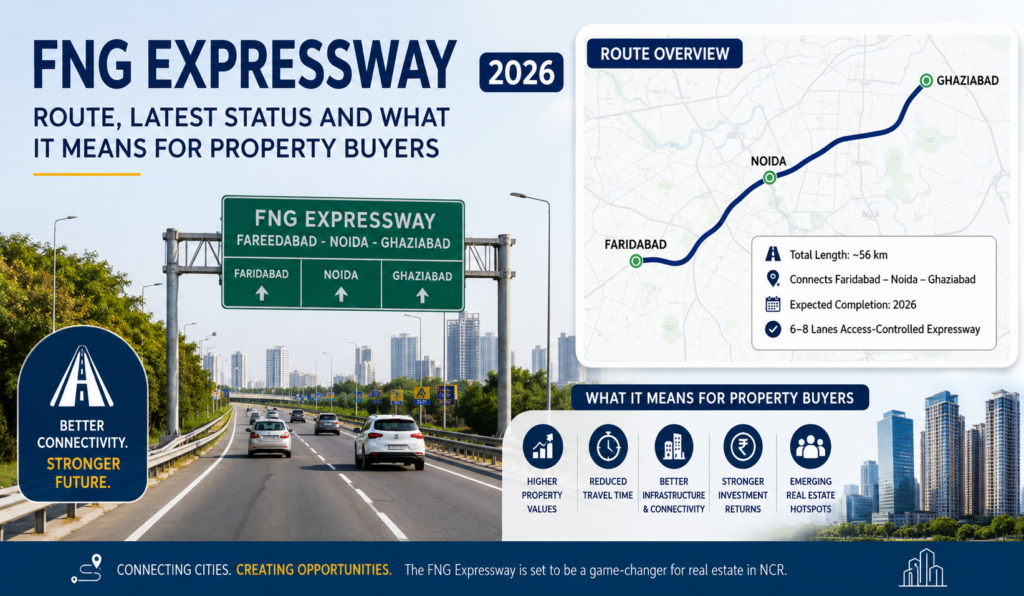
The FNG Expressway is one of those infrastructure projects that NCR has been waiting on for so long that many buyers had stopped believing in it. Yet in 2026, the Faridabad-Noida-Ghaziabad Expressway is finally showing real momentum, and for anyone looking at property across these three cities, that changes the calculation. Here, the Prateek Properties team explains where the project actually stands and how it is likely to shape real estate along the corridor.
Table of Contents
- What Is the FNG Expressway?
- FNG Expressway Route and Key Connectivity
- FNG Expressway Latest Status in 2026
- FNG Expressway Expected Completion Date
- How the FNG Expressway Will Affect Property Prices
- Areas Likely to Benefit From the FNG Expressway
- FNG Expressway Impact on Residential and Rental Demand
- Risks to Consider Before Investing Near the FNG Expressway
- Is It a Good Time to Invest Near the FNG Expressway?
- Frequently Asked Questions About the FNG Expressway
What is the FNG Expressway?
The FNG Expressway is a roughly 56 km greenfield corridor designed to directly connect Faridabad in Haryana with Noida, Greater Noida and Ghaziabad in Uttar Pradesh, without forcing traffic through Delhi. Today, a commuter travelling between these cities often has to take the congested Kalindi Kunj route, turning what should be a short hop into a journey of well over an hour. The expressway is built to fix exactly that.
Once fully operational, it is expected to cut travel time between the three cities by around 40 minutes and offer relief to tens of thousands of daily commuters. It also forms part of the wider National Expressway network and links into the Eastern Peripheral Expressway system.
FNG Expressway route
The corridor is split across three stretches:
- Noida and Greater Noida: Roughly 20 km, starting near Sector 94, threading past sectors including 121, 122, 140, 143 and 150, and ending near Sector 168. It includes elevated stretches and an interchange with the Noida-Greater Noida Expressway. A portion of this stretch is already operational.
- Ghaziabad: About 8 km, connecting toward the Delhi-Meerut Expressway.
- Faridabad (Haryana): The largest single stretch at roughly 28 km.
The critical missing link is a bridge over the Yamuna River, around 600 metres long, near Mangroli village, connecting Noida’s Sector 168 side to Faridabad. Without it, the corridor cannot function end to end.
FNG Expressway latest status in 2026
Here is the honest, up-to-date picture. For years, only a short 3 km stretch was operational, with the Noida side seeing the most progress, well over half complete, while the Haryana section lagged and land acquisition, delayed project reports and bureaucratic hurdles slowed everything down.
The turning point has been a formal agreement between the Noida Authority and Faridabad’s development authority to jointly fund and finish the project, with Uttar Pradesh and Haryana splitting the cost of the crucial Yamuna bridge equally. The Haryana government has now placed the FNG Expressway among its flagship projects, a new detailed project report has been prepared for the unfinished sections, and route surveys have been completed.
On timelines, the working targets point to the Ghaziabad segment being completed first, with the full corridor including the Faridabad stretch and the Yamuna bridge expected to become operational around 2027. As with any large inter-state project, these dates can move, so treat them as a direction of travel rather than a guarantee.
How the FNG Expressway will affect property prices
This is the part that matters most to buyers and investors. Infrastructure of this scale tends to influence real estate in three phases.
1. The announcement and revival phase (now). Renewed momentum and joint funding have already put the corridor back on investors’ radar. Sectors along the alignment in Noida and Greater Noida West, and in Greater Faridabad, are attracting fresh attention.
2. The construction phase. As bridges, underpasses and feeder roads take shape, and as patch roads connect Greater Noida West to Greater Faridabad, accessibility improves in stages. Values in well-located pockets typically firm up during this period.
3. The operational phase. History across NCR shows the biggest, most durable jump usually comes when a road actually opens and commute times drop in real life. The FNG is expected to benefit more than 30 sectors and over a thousand industries along its route, which supports both residential demand and rental yields.
For end-users, the appeal is straightforward: shorter commutes, better access to jobs across two states, and a stronger resale story. For investors, the FNG corridor offers the classic infrastructure-led upside, buy while the road is still under construction, benefit as it becomes operational.
A balanced word of caution
Expressway-led investing works best when you respect the risks. Timelines on inter-state projects can slip, so never buy purely on a promised completion date. Focus on locations that already have partial connectivity and independent demand drivers, verify RERA registration, and avoid over-leveraging on speculation. A plot or flat that only makes sense if the road opens on schedule is a gamble; one that makes sense today and gets better when the road opens is an investment.
Frequently Asked Questions
Q. What is the FNG Expressway?
It is a roughly 56 km greenfield expressway connecting Faridabad, Noida, Greater Noida and Ghaziabad directly, bypassing Delhi to cut travel time by around 40 minutes.
Q. What is the FNG Expressway completion date?
Working targets suggest the Ghaziabad segment finishes first, with the full corridor, including the Faridabad stretch and Yamuna bridge, expected to be operational around 2027, subject to change.
Q. Why was the FNG Expressway delayed for so long?
Land acquisition issues, delayed detailed project reports, funding gaps and inter-state coordination hurdles stalled progress, until Noida and Faridabad authorities agreed to jointly fund and complete it.
Q. Which areas will benefit most from the FNG Expressway?
Sectors along the alignment in Noida and Greater Noida West, Greater Faridabad and the Ghaziabad end connecting to the Delhi-Meerut Expressway stand to gain the most.
Q. Is it a good idea to invest near the FNG Expressway now?
It can be, if you choose locations with existing partial connectivity and independent demand, verify RERA status and avoid over-leveraging on the completion date alone.