
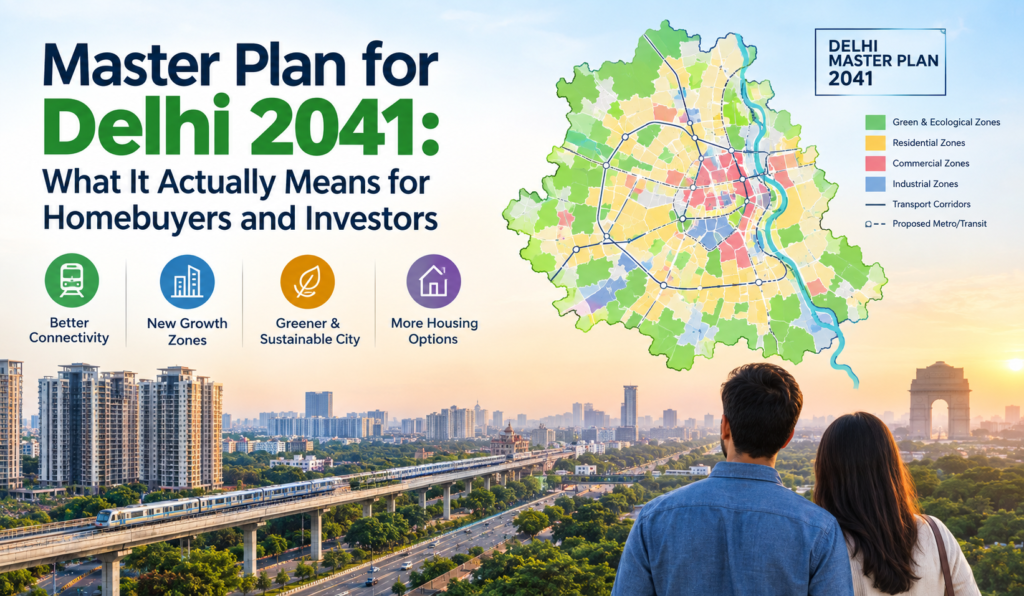
f you’ve been searching for the “Master Plan for Delhi 2047,” here’s the first thing worth knowing: the official document is the Master Plan for Delhi 2041, prepared by the Delhi Development Authority (DDA). The “2047” version people type into Google usually gets mixed up with the government’s wider Viksit Bharat @2047 goal. Same city, same ambition to modernise but the statutory blueprint that will actually govern where and how Delhi grows is MPD-2041.
We get asked about this a lot at Prateek. Buyers hear “master plan” and assume it’s abstract policy talk. It isn’t. This single document decides which land can be built on, how tall your building can go, where the next metro-linked hub lands, and which unauthorised colonies finally get a legal footing. If you’re buying, selling, or holding property anywhere in the National Capital Region, the Master Plan for Delhi 2041 quietly shapes the value of what you own.
Table of Contents
- What Is the Master Plan for Delhi 2041?
- Master Plan for Delhi 2041 vs 2047: Clearing Up the Confusion
- Key Features of the Master Plan for Delhi 2041
- Current Status of the Master Plan for Delhi 2041 (2026 Update)
- What the Master Plan for Delhi 2041 Means for Delhi-NCR Property Buyers
- How It Connects to Noida, Greater Noida and Ghaziabad
- FAQs About the Master Plan for Delhi 2041
What Is the Master Plan for Delhi 2041?
Think of it as Delhi’s rulebook for the next two decades. Every 20 years or so, the DDA lays out a fresh vision for the capital under the Delhi Development Act, 1957. MPD-2041 is the fourth such plan. The first one arrived back in 1962 (it was also the first master plan ever made in India), followed by plans for 2001 and 2021.
The 2041 edition was drafted after real public consultation. When the DDA opened it up for feedback in 2021, it received roughly 33,000 objections and suggestions from residents, developers, and civic groups. That’s not a rubber-stamp exercise — a lot of the final shape came from ordinary Delhiites pointing out what wasn’t working.
The stated vision is simple to say and hard to pull off: make Delhi a sustainable, liveable, and vibrant city by 2041. Underneath that headline sit six big policy areas — environment, economy, mobility, heritage and culture, housing and social infrastructure, and physical infrastructure like water and power.
Master Plan for Delhi 2041 vs 2047: Clearing Up the Confusion
Since so many people search for both, let’s settle it clearly.
- Master Plan for Delhi 2041 (MPD-2041): the actual, legally-backed development plan from the DDA. Its “perspective year” is 2041, meaning it plans the city’s growth up to that point. This is the document that matters for zoning, land use, and approvals.
- “Master Plan for Delhi 2047”: not a separate DDA plan. The 2047 figure comes from Viksit Bharat @2047 — India’s national goal to become a developed nation by its 100th year of independence. It’s a vision, not a zoning document.
So if a listing, article, or agent references a “Delhi Master Plan 2047,” they almost certainly mean MPD-2041. Knowing the difference keeps you from chasing paperwork that doesn’t exist.
Key Features of the Master Plan for Delhi 2041
This is where the plan gets interesting for anyone with skin in the property game. A few provisions stand out.
Transit-Oriented Development (TOD)
The idea here is to build denser, mixed-use neighbourhoods around metro stations and major transit corridors, so people can live, work, and shop without depending on a car. For property, TOD zones typically allow higher density and taller construction near stations — which tends to lift land value along those corridors. If you own or are eyeing a plot near a metro line, this is the clause to watch.
Land Pooling Policy
Land pooling is one of the plan’s most talked-about tools. In simple terms, small landowners in designated zones pool their plots together, hand them to the development agency, and receive a share of the developed, serviced land back once infrastructure is in place. Done right, it unlocks large tracts of the city for planned housing instead of the haphazard sprawl Delhi has struggled with. It’s also one of the sections still being finalised, so timelines matter.
Affordable and Rental Housing
MPD-2041 puts real weight on housing that ordinary people can actually afford including public rental housing and smaller-format homes. Delhi has a huge floating population of students, workers, and young professionals who don’t want to buy but need somewhere decent to rent. The plan tries to bring that demand into the formal, regulated market rather than leaving it to informal arrangements.
Green-Blue Infrastructure and the Yamuna
“Green” spaces and “blue” waterbodies get a dedicated push. The plan treats the Yamuna riverfront, biodiversity parks, and city lakes as assets to revive, not obstacles to build around. There’s a clear focus on cutting pollution and stopping untreated waste from flowing into the river. For homebuyers, greener surroundings and cleaner air aren’t just lifestyle perks they increasingly drive resale demand.
A 24×7 City and Night-Time Economy
For the first time, a Delhi master plan openly encourages nightlife and a night-time economy extended commercial hours, more mixed-use zones, and space for the city’s economy to run around the clock. This is a quiet nod to how younger, working Delhi actually lives, and it opens doors for retail, hospitality, and commercial investment.
Regeneration of Old Areas and Unauthorised Colonies
A big chunk of Delhi grew without formal planning. MPD-2041 lays out how unauthorised colonies and ageing urban villages can be redeveloped, regularised, and brought up to standard. If your property sits in one of these pockets, notification of the plan could directly affect its legal status and market value.
Current Status of the Master Plan for Delhi 2041 (2026 Update)
Here’s the honest part. As of 2026, the Master Plan for Delhi 2041 has been approved at the draft stage but not yet formally notified. Delhi’s Lt. Governor cleared the draft back in early 2023, and it has been sitting with the Union Ministry of Housing and Urban Affairs (MoHUA) for final sign-off. Ministers have said more than once that notification is coming “soon.”
Until it’s officially notified in the gazette, the previous plan MPD-2021 technically still governs decisions on the ground. That single fact catches a lot of buyers off guard.
What does the delay mean for you? Two practical things:
- Don’t treat draft provisions as final. Land pooling boundaries, green-zone demarcation, and density rules can shift before notification.
- The moment it’s notified, expect movement. Long-stuck land and redevelopment plans could suddenly get the green light, and prices in the affected zones tend to react quickly. Buyers who understand the plan early are usually the ones who move first.
What the Master Plan for Delhi 2041 Means for Delhi-NCR Property Buyers
Strip away the jargon and the plan is really about three things buyers care about: where new supply comes from, how connected it is, and how liveable it feels.
More planned land through pooling means more legitimate, RERA-compliant projects instead of grey-market plots. TOD means the best-connected addresses get denser and more valuable. The green-blue push and pollution focus mean the healthier pockets of the city command a premium. If you’re investing for the long term, these are exactly the signals to read.
It’s also a reminder to buy on fundamentals, not hype. Verify the land use, check that a project is RERA-registered, and understand which plan is actually in force before you commit.
How It Connects to Noida, Greater Noida and Ghaziabad
Delhi doesn’t grow in isolation. It sits at the centre of a National Capital Region spanning roughly 55,000 sq km, and the capital’s own decongestion is a big reason NCR satellite cities keep booming. As MPD-2041 pushes population and economic activity outward and prioritises regional connectivity, the corridors into Noida, Greater Noida, and Ghaziabad stand to benefit directly.
This is the market we know best. With metro expansion, the Noida–Greater Noida expressways, and the upcoming Jewar (Noida International) Airport, the eastern and southern edges of NCR are where a lot of tomorrow’s demand is heading. A planned, connected Delhi makes these locations more attractive, not less.
If you’re weighing where to buy while the Delhi picture settles, our team can walk you through RERA-approved options in exactly these growth corridors. Explore Prateek Group projects across Noida and Ghaziabad →
FAQs About the Master Plan for Delhi 2041
Q1. Is it the Master Plan for Delhi 2041 or 2047?
The official, statutory document is the Master Plan for Delhi 2041 (MPD-2041), prepared by the DDA. “2047” usually refers to the national Viksit Bharat @2047 vision, not a separate Delhi master plan. When people search “Master Plan for Delhi 2047,” they almost always mean MPD-2041.
Q2. Who prepares the Master Plan for Delhi 2041?
The Delhi Development Authority (DDA) prepares it under the Delhi Development Act, 1957. It then needs approval from the Union Ministry of Housing and Urban Affairs before it can be notified.
Q3. Has the Master Plan for Delhi 2041 been notified yet?
Not as of 2026. The draft was approved but is still awaiting final notification from MoHUA. Until then, the earlier MPD-2021 remains the plan in force for on-ground decisions.
Q4. What are the main features of MPD-2041?
The headline provisions include Transit-Oriented Development, the land pooling policy, affordable and rental housing, green-blue infrastructure and Yamuna revival, a 24×7 night-time economy, and regeneration of unauthorised colonies and old areas.
Q5. How does the Master Plan for Delhi 2041 affect property prices?
By deciding land use, density, and connectivity, the plan directly shapes where value grows. TOD corridors, newly pooled land, and cleaner, greener zones typically see stronger demand. Big movements often follow the plan’s formal notification.
Q6. What is land pooling in the Delhi Master Plan 2041?
Landowners in designated zones pool their plots with the development agency, which develops the land with roads, utilities, and infrastructure, then returns a share of the serviced land to the owners for planned construction.
Q7. Does the Delhi Master Plan affect Noida and Ghaziabad?
Indirectly, yes. Delhi’s decongestion and regional connectivity goals push growth toward NCR satellite cities. Better-planned corridors and transport links make Noida, Greater Noida, and Ghaziabad more attractive to buyers and investors.
Looking for a home or investment in Delhi-NCR that’s ready for the city’s next chapter? Prateek Group has delivered 20M+ sq. ft. and 50,000+ homes across Noida, Greater Noida, and Ghaziabad since 2005 all RERA-compliant. Book a site visit or talk to our team today.